Architecture & Integration
AI agents or workflows: choosing where autonomy belongs
An agent can decide how to investigate an exception without being allowed to approve its own action. A practical framework for placing autonomy where it improves business outcomes.
By Kenneth Okeke
A supplier invoice does not match its purchase order. Someone must work out whether the discrepancy comes from a partial delivery, an agreed price change or an error. An AI agent might investigate the records and recommend the next step. But should it also change the invoice, approve the exception and release payment?
Those are separate design decisions. Treating them as one decision about “using agents” obscures where the business needs flexibility and where it needs predictable control.
My view is that autonomy should be assigned to specific decisions within a process. Give the model room to investigate uncertainty where that improves the outcome. Keep authority to make consequential changes explicit and independently enforced.
Distinguish a flexible step from an autonomous process
A workflow can use AI without handing over control of the process. Code might retrieve an invoice, ask a model to extract its fields, validate the result and route discrepancies to an owner. The model interprets the document; the application determines what happens next.
An agent can select its next tool or investigative step based on what it discovers. Anthropic makes this distinction in its December 2024 architectural guidance: workflows follow predefined paths, while agents dynamically direct their process and tool use. The page now cautions that its tooling landscape has changed; the distinction remains useful for this design question.1
Predictable orchestration does not make a model’s output deterministic or correct. Both designs still need validation. The difference is how much discretion the model has over the path through the work.
Decide where that discretion is useful
I would assess each part of the process against four questions:
| Question | Design implication |
|---|---|
| Can the next steps be specified reliably in advance? | Use a defined workflow for those steps. |
| Does new evidence change what needs investigating? | Consider an agent with a restricted set of investigative tools. |
| Could an incorrect action create a difficult-to-reverse consequence? | Separate the recommendation from authority to execute it. |
| Can the result and policy compliance be independently checked? | Define those checks before expanding autonomy. |
This is a proposed decision framework, not a universal standard. An open-ended task may suit an agent, but vague success criteria make it hard to justify wider deployment. A highly structured task may need a model for one awkward input without needing an agent to run the whole process.
The commercial question is whether discretion resolves valuable cases that the simpler design cannot handle well enough.
Example: investigating an invoice exception
Consider a hypothetical finance operation. This is an illustrative design, not a customer implementation or a claim about its performance.
The existing workflow validates required fields, checks for duplicate invoices and compares purchase-order and receipt records. Invoices that satisfy the organisation’s established rules continue through its normal processing route.
For an exception, a restricted agent can retrieve the relevant purchase order, receipts and authorised supplier correspondence. It chooses what to inspect next and returns a proposal containing the discrepancy, supporting records, missing evidence and a recommended resolution. It cannot change supplier bank details or release payment.
A separate application applies policy checks and routes the proposal to an authorised person when required. Any approved update passes through a controlled API. Before execution, the application checks that the approval covers this exact proposed change and that the underlying records have not materially changed.
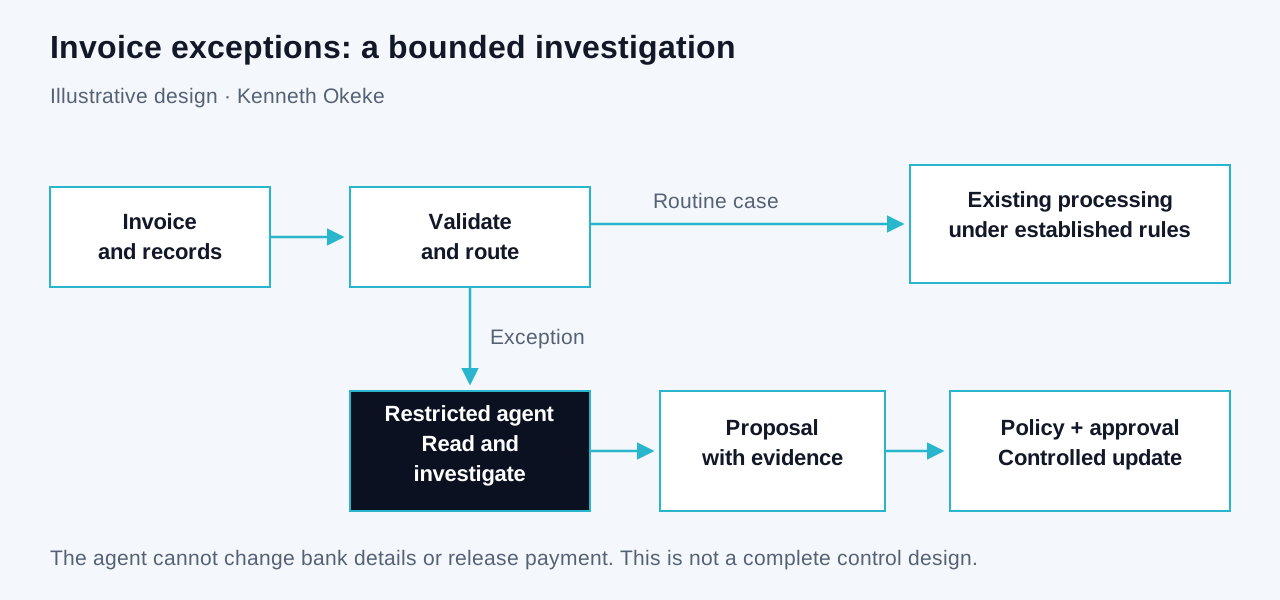
Invoice data enters validation and routing. Routine cases follow existing processing. Exceptions go to a restricted agent with read tools. Its proposal and evidence pass to a separate policy and approval gate before a controlled update. The agent cannot change bank details or release payment.
Set a time or tool-use budget and a clear hand-off when evidence is missing. When an API times out, check the status of the original operation before retrying. Use an operation identifier and duplicate protection so a retry does not apply the same change twice.
This design adds discretion to the investigative work while retaining a clear owner for the financial decision. It also gives the organisation a smaller capability to test and improve.
Integration defines the agent’s practical authority
A prompt saying “do not make unauthorised changes” is insufficient as the sole control. The tools and credentials available to the application must enforce what is allowed.
Prefer narrowly defined operations, such as retrieving one permitted invoice or submitting a proposed resolution, to unrestricted database access. Validate the caller, record access, parameters and permitted state transition on the server. Keep retrieved emails and documents separate from trusted operating instructions: their content is evidence to inspect, not authority to expand the task.
MCP can provide a standard way to expose tools, but adopting it does not settle business permissions. Its security guidance explicitly rejects token passthrough and requires servers to accept only tokens issued for them.2 The business still needs to decide which records and actions each identity may access.
There is a related lesson in Anthropic’s April 2026 account of Managed Agents: it separates execution environments from credentials and maintains session state outside the execution component.3 That is a vendor implementation, not a required product choice. My inference is that replaceable reasoning components should sit behind stable interfaces for identity, state and business actions.
Compare designs on the same business task
Before funding a broad agent deployment, compare three candidates on representative historical exceptions:
- The current process or existing automation.
- A defined workflow with targeted model calls.
- A restricted agent that can choose its investigation steps.
Use records the organisation is authorised to test, isolate evaluation from production writes, and reserve cases that were not used to tune the designs. Include incomplete receipts, contradictory correspondence, repeated requests and attempted instructions embedded in supplier documents.
Judge the proposal against the evidence and check the resulting application state. Anthropic’s January 2026 evaluation guidance distinguishes an agent’s account of what happened from the actual final state of the environment.4 A plausible explanation is not proof that the invoice was correctly updated. Repeat tests where variable behaviour could affect the decision.
Measure correct resolutions, inappropriate actions, review effort and completion time, including slow cases. Calculate operating cost per correctly resolved case using the costs of all attempts, failures and retries. Separately budget implementation, integration, evaluation, monitoring, maintenance and process change. These figures inform an investment decision; they are not a complete ROI calculation by themselves.
If an agent improves difficult exceptions but adds expense to routine work, routing only those exceptions to it may be the stronger design.
Require a reason for every extra agent
A second agent may help when the work separates into genuinely useful parallel investigations. It also creates coordination and evaluation work.
In its June 2025 research-system account, Anthropic reported that its multi-agent systems used about 15 times the tokens of chats. This was an observation about its own systems, not a current price multiplier or a benchmark for finance automation.5 It illustrates why an impressive capability demonstration is not enough to select an architecture.
I would expand autonomy only when comparison shows a meaningful improvement in the required outcome, with acceptable cost and failure behaviour. Where a fixed workflow performs adequately, retain it. Where investigation needs flexibility, grant that flexibility with explicit tools, limits and accountable hand-offs.
The architectural decision is precise: which choices should the model make, what authority should it have, and what evidence would justify giving it more?
Sources
- Anthropic, Building effective agents, published 19 December 2024; live page includes a notice about subsequent tooling changes.
- Model Context Protocol, Security Best Practices, documentation under the 2026-07-28 version path. The version label is not treated here as a verified publication date.
- Anthropic, Scaling Managed Agents: Decoupling the brain from the hands, published 8 April 2026.
- Anthropic, Demystifying evals for AI agents, published 9 January 2026.
- Anthropic, How we built our multi-agent research system, published 13 June 2025.
Sources checked 28 September 2026. Vendor observations are attributed, not presented as independent evidence of business benefits. The invoice scenario and design recommendations are illustrative author proposals.